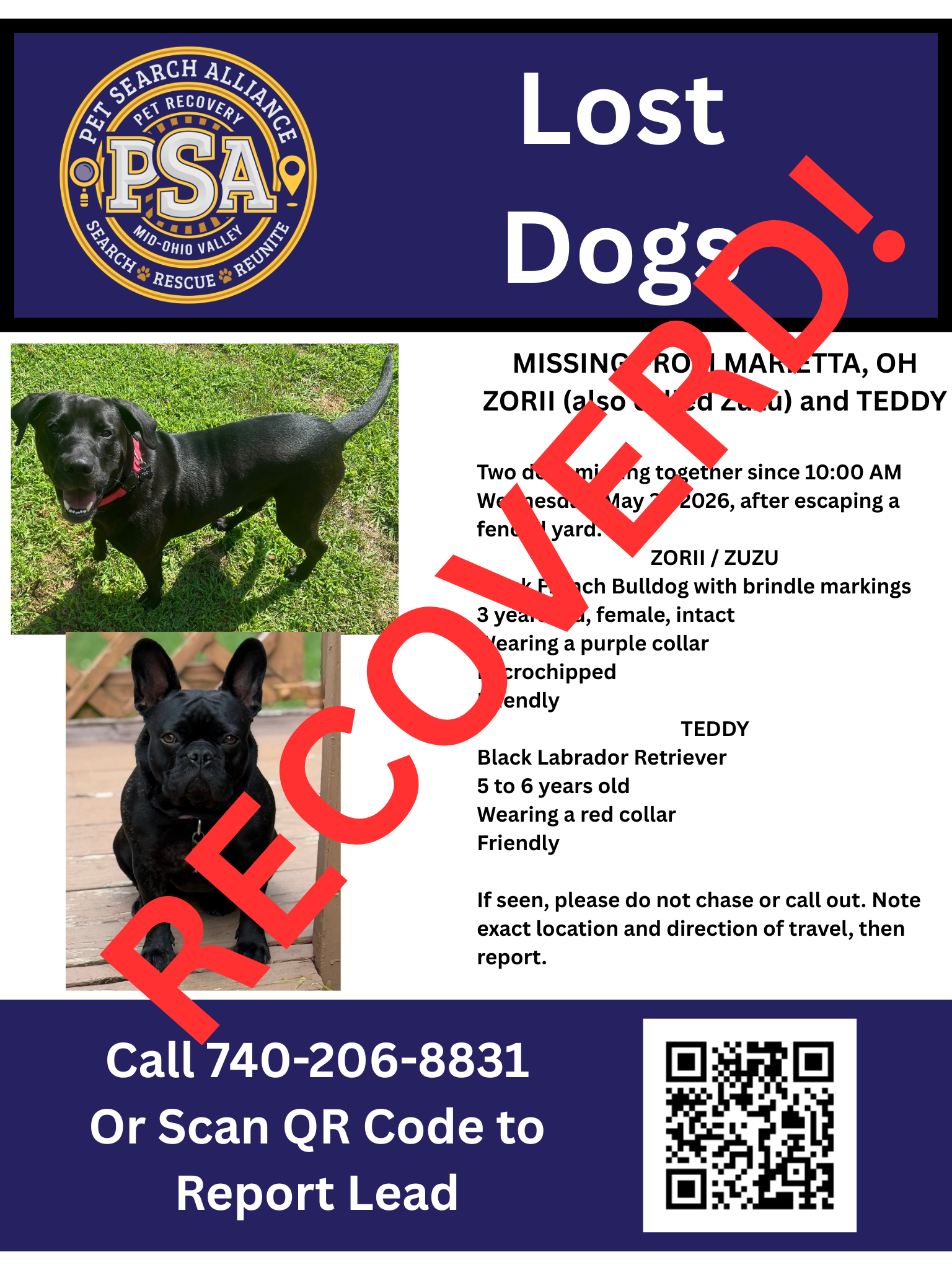
ZORII AKA Zuzu Missing From Oak Grove OH.
At 11:50 in the morning on the thirteenth day, a woman walked into a patch of Marietta woods, said a name out loud, and a small black French Bulldog walked out to meet her. This is the story of everything that had to happen for that one moment to be possible.
The Fence
Most lost-pet stories begin with something ordinary. A door left cracked. A gate that latched on the second try instead of the first. A fence with a soft spot nobody noticed. Zorii's story begins with a fence.
It was Wednesday morning, May 27th. Ten o'clock. Jessica McAtee's two dogs were in the yard, the way they were on any other morning. Teddy, a black Labrador with the kind of loose, joyful face Labs are famous for. And Zorii, a three-year-old French Bulldog with brindle markings nobody who has met her ever forgets. Zorii goes by Zuzu to the people who love her, which is most people who meet her.
And then, the way these things always go, they were gone.
Teddy came home that same day. Not because anyone tracked him down. Because somebody saw him, recognized that a dog wandering loose was a dog that needed help, and did something about it. A good Samaritan got him into a garage, closed the door, called Jessica, and waited. That is the entire job description. See a dog. Contain a dog. Make a call. By dinnertime on day one, the family was halfway home.
Zorii was a different story.
The Ping That Came and Went
Her AirTag pinged once that first day, on the 100 block of Oak Grove Lane in Marietta. Just once. A witness saw a small black blur of a dog running through the Oak Grove area shortly after. We pulled out the thermal drone and flew sections of that corridor as the sun went down. The thermal camera turned up nothing. That, in itself, was not unusual. A French Bulldog tucked under a porch or wedged into a brush pile gives off almost no heat signature a drone can pick up at altitude. We packed up and waited for the next ping.
It did not come.
One day. Two days. A week. The AirTag stayed silent.
By the end of the first week, the conversations were getting harder. Not with Jessica, who was holding the line. With ourselves. With our team. We had to start asking the questions nobody wants to ask out loud. Was she still alive in those woods? Had someone picked her up? French Bulldogs are not a casual breed. They are not strays that blend into a neighborhood. They are a sought-after dog, the kind a person sees, recognizes the dollar sign in, and slides into the back of a vehicle without calling anyone.
We did not say it out loud at first. We sat with it.
What the Family Did
If there is a single thing that separates the families who get their dogs back from the families who do not, it is what Jessica and her people did over the next twelve days.
They flyered the entire downtown area of Marietta. If you live anywhere in town, you have probably seen one of their flyers stapled to a telephone pole, or a yard sign tucked into a corner lot, or a notice taped to the inside of a coffee shop window. They did not pick out the busy streets and stop there. They walked Indian Run Road. They walked Mound Drive. Oak Grove. Front Street. They put flyers in mailboxes by hand. They drove to every fire department within range and asked the crew on duty to keep the flyer up. They called every single veterinary clinic in the area and left Zorii's description on file, just in case someone walked in with a small black Frenchie and a story.
Jessica's parents and her stepdad spent days walking corridors and woods, holding their phones out like dowsing rods, hoping the AirTag would catch a Bluetooth signal from one of their devices and finally ping. Her husband joined searches after work. The whole family kept moving.
On day five, Jessica found something. She was walking the wooded area between an Indian Run Road sighting and the spot where Shamrock Drive meets Waterford Road, the same patch of trees we had been circling on every map. She looked down. Paw prints. Two sets. Both dogs had walked that trail together, heading back toward Oak Grove. The Shamrock sighting we had filed away as Teddy was almost certainly both of them.
It was the first real evidence in days. And it was the kind of evidence that can break your heart, because trails end. The prints stopped somewhere out there, and the silence picked up again.
The Person Who Was Paying Attention
If this story has a hero who has not been named yet, it is them. We do not know exactly who they are. We just know that somewhere in this community, a person has a trail camera mounted at the edge of their woods near the Marietta Silos. And on a recent night, that camera caught something.
A small black dog. Walking through frame. Twice in twenty-four hours.
This person could have scrolled past it. Most people would have. A flash of fur on a low-resolution clip in the middle of the night is the kind of thing a person glances at and dismisses. Raccoon. Stray. Neighbor's dog cutting through. Skip.
They did not skip. They thought about it. They remembered, somehow, that there was a Frenchie missing in town. They sent the footage. Jessica watched it. Three words.
And then, late the night before, the AirTag updated. For the first time in nearly two weeks, a phone walked close enough to wake it up. Maybe a property owner checking a fence line. Maybe somebody out for a late walk. Maybe a worker passing through. We will never know. We do not need to know. The point is that it happened, and it gave us a location to focus on, and the trail cam footage backed it up. The same wooded corridor. The same dog.
For the first time in twelve days, we had a place to go.
The Last Hour
What people do not see, in stories like this, is what the last hour looks like from the inside.
MOV Drone Workz was in route to the area with the thermal drone, ready to fly the corridor and confirm her position. The PSA trap trailer was almost on scene, ready to position a soft, baited live trap on a property near the last ping. A feed station was lined up. A trail camera was queued. Property owners were saying yes. The neighbor near the silos had agreed to let us drop a trap on his land. Everything was about to happen at once.
And that is what people need to understand about cases like this. The story you read on the internet says "the dog came out of the woods on her own." It sounds simple. It sounds like luck. But every dog that walks out of the woods on her own is walking into a moment that a dozen people built for her. The drone was coming. The trap was coming. The family was on the ground. The trail cam owner had spoken up. The corridor had been mapped, walked, and re-walked. None of it was visible from the outside. All of it was holding the door open.
Today was the day Zorii was getting caught. One way or another.
Jessica got there first.
She drove to the search corridor because she wanted to be close. She wanted to be there if the trap worked. She parked. She walked into the woods near the spot the AirTag had pinged the night before. She moved slowly. And somewhere in those trees, a small black French Bulldog who had been running and hiding and surviving for thirteen days heard her mom and made a choice.
Three words. That is the whole story. Zuzu walked out of the trees and into Jessica's arms.
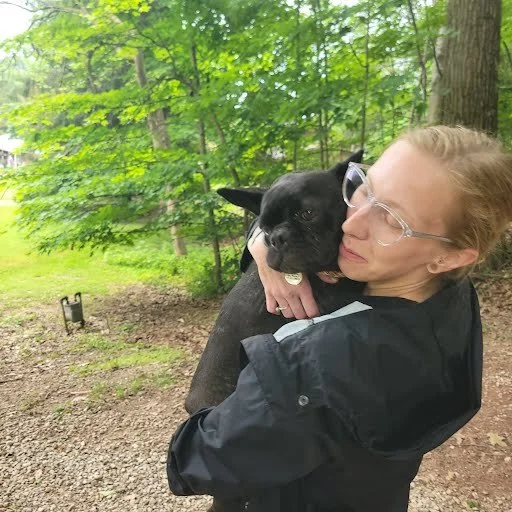
The first thing she did was hold her. The second thing she did was put her in the front seat of the car and drive her straight to the vet.
So, About Those AirTags
Every time we run a case like this, we get the same question afterward. Do AirTags actually work? Should I put one on my dog?
The honest answer is yes, with an asterisk.
An AirTag is not a GPS tracker. It does not call home. It does not broadcast its location into space. What an AirTag does is sit there, quietly, waiting for any iPhone within Bluetooth range to walk past. When one does, that iPhone, completely anonymously, relays the tag's location to Apple's Find My network. The tag itself contributes nothing without a passing phone to wake it up.
In a dense neighborhood, this is fine. iPhones are everywhere. A lost dog in a suburb will trigger a ping every few minutes. In rural Ohio, on private acreage, in steep wooded terrain where nobody walks for days at a stretch, the math changes completely. Zorii spent most of her thirteen days in a corridor of woods between Oak Grove, Indian Run, and the Marietta Silos. Heavy cover. Almost no foot traffic. The tag was doing its job the entire time. There was just nothing within range to do anything with the signal it was sending.
What this means for owners
Put the AirTag on your dog. We mean it. When it works, it is brilliant. The catch is that you have to layer other tools alongside it, because the tag will not be enough on its own. Trail cameras. Doorbell cameras. Flyers. Yard signs. Knocks on doors. A community that knows your dog is out. Zorii's case is the cleanest possible example of how this works in practice. The AirTag was the breadcrumb. The trail cam was the proof. The family on the ground was the recovery. Three tools, layered. None of them alone would have done it.
The Rule You Have to Remember
If there is one sentence from this whole story that we want people to take with them, it is this.
By day eight, the shares had slowed. The comments thinned out. The tips that had been coming in steady the first weekend had dropped to almost nothing. This is what happens in every long case. The community moves on, even when they do not mean to. The algorithm pushes the post down. People assume someone else has it handled. The case starts to feel like background noise.
Jessica did not stop. Her family did not stop. We did not stop. And because none of us stopped, the trail camera owner was still seeing flyers in town the week he scrolled through his footage and saw a small black dog. He had a name in his head when he saw the clip. That is the only reason he spoke up.
If we had taken the posts down on day seven, that man scrolls past that clip and Zorii is still in the woods tonight. If Jessica had stopped flyering on day six, he never has the name in his head in the first place. The work is the work. You do not get to skip the long days and expect the recovery on day thirteen.
Most reunions happen in the second week. The third. Sometimes the second month. They almost never happen on day one for a scared dog. The families who get their dogs back are not the lucky ones. They are the families who refused to stop.
- Watch social media for tips and leads
- Share posts to spread the word
- Place and rotate yard signs
- Print and distribute flyers
- Set, monitor, and reset live traps
- Field search and corridor walking
- Drone pilots (Part 107 or in training)
- Digital and media support
- Serve as family point-of-contact
- Fundraising and event support
- Local-area alert subscribers
- Photography and case documentation
The People Who Brought Her Home
This was never one person. It was an entire community of people who said yes when it was their turn to say yes.
It was Jessica and her husband, who held it together for thirteen days and never stopped showing up. It was her parents and her stepdad, who walked corridors and woods until their feet hurt. It was the good Samaritan who recovered Teddy on day one and reminded all of us that the simplest acts of awareness are the ones that save dogs. It was the property owners along Indian Run, Shamrock, Waterford, and Oak Grove who let strangers walk their land because they understood what was at stake. It was Mark and Donna and the neighbors near the silos who were ready to host a trap on short notice without asking for anything in return. It was Matthew, who coordinated trap-site logistics in real time on the morning of the recovery. It was the team at MOV Drone Workz, who were in route with thermal drone support when the call came. It was every veterinary clinic in the area that picked up the phone, kept Zorii's information on file, and stayed on alert. It was the trail camera owner whose footage cracked the case open. It was the person, whoever they were, who took the time to report what they saw.
It was over three hundred people on Facebook who shared the post, commented their support, and kept her name moving when the algorithm wanted to bury it.
It was the PSA Mid-Ohio Valley volunteer team, monitoring the tip line around the clock, coordinating drone runs, building case pages, drafting updates, mapping corridors, and refusing to let this case quietly fade.
Teddy on day one. Zorii on day thirteen. Two dogs. Two recoveries. One community.
Welcome home, Zuzu.